The Souvenir That Claims to Tell a Whole Place
A souvenir cannot represent an entire place. Learn to read keepsakes as personal snapshots and choose one that carries a memory without claiming the whole.
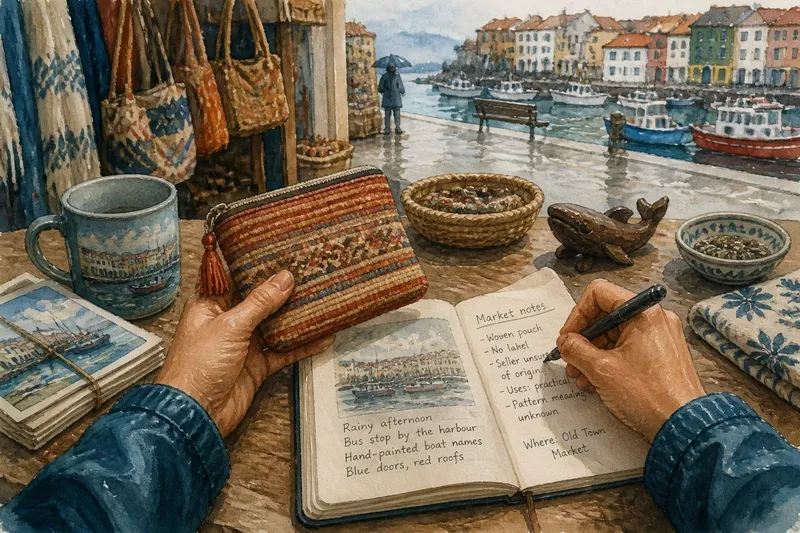
What can one souvenir really tell you about a place? A souvenir can tell you where you stood, what caught your eye and which story you wanted to carry home; it cannot speak for everyone who lives there. A mug bearing a skyline, a carved animal or a packet of local sweets is a snapshot, not a portrait of a whole community.
That distinction need not make keepsakes less meaningful. It can make them more interesting. Instead of asking whether an object represents a destination, ask what kind of encounter it records—and what it leaves outside the frame. A little attention to where an object comes from and what you know about it can help you bring home something personal without mistaking it for a cultural summary.
Notice what a souvenir leaves out
Souvenir shops often favour images that read quickly: a recognisable building, a flag, a local animal or a decorative pattern. Such images can be appealing and may carry genuine significance. But a tidy emblem turns a varied place into a simple message, shaped by the choices of makers, sellers and visitors.
Look at the object as an edited view. A postcard of a harbour may show boats and bright water but not the routines behind them. A textile printed with a familiar motif may be sold far from the community or craft tradition associated with that design. The object is not necessarily dishonest; its limits are part of what it can tell you.
As you look around, notice which images recur in shop windows, on public signs, in markets or on packaging—and which details appear in the places people use every day. You are not trying to identify an official symbol. You are learning to see how different settings select different versions of a place.
Record the details that caught your attention
Jot down a few concrete observations in a notebook or phone: a sound from a street, the shape of a doorway, a colour on ordinary shopfronts or the way a meal was served. Add where you noticed it. A detail seen at a market is not the same claim as a detail presented as universal.
This record gives a future keepsake a more honest companion. A ticket, a folded map or a small craft object can stand for one afternoon or one conversation, rather than being asked to represent a region. Even a mass-produced key ring can hold a personal memory if you know what it reminds you of.
Say you spend a rainy afternoon in a coastal town and notice hand-painted boat names while waiting for a bus. You choose a postcard showing the harbour and write on its back that it recalls the wait and the names you read. The card then preserves your encounter, not evidence that every resident thinks of the town through its boats.
Ask who made the object and how it is used
When you find an item you like, look for its maker, material and intended use. Is it made nearby, designed for visitors or produced elsewhere with a local image? Is the pattern decorative, ceremonial, practical or simply fashionable? A seller may know the answers, or may not. Either way, the questions help you distinguish what you know from what you are guessing.
At a craft stall, you might ask whether a woven piece is made locally and whether its motif has a particular meaning. If the answer is uncertain, do not turn the design into a confident story later. You can still value its colour, texture or connection to the conversation. If an item is presented as sacred, restricted or belonging to a specific community, take the maker’s guidance seriously and leave it alone if it is not offered for sale.
Material matters, too. A clay cup, printed cotton scarf and enamel badge each carry different information about making, use and trade. None is automatically more authentic than another. A factory-made object may be part of the visitor economy; a handmade object may have been made for many audiences. Ask instead: “What can I responsibly say about this particular object?”
How can you choose a souvenir responsibly?
Does a souvenir have to be made locally?
No, but its origin changes the story you can tell. If local production matters to you, check the label or ask the seller rather than inferring it from a place name or a traditional-looking design.
Is a familiar symbol always misleading?
No. A symbol can be meaningful and widely recognised while still representing only one part of a place. Treat it as a particular sign with a history or use, not as a complete account of local identity.
What if you cannot learn the object’s full story?
Keep your description narrow: name the material, where you encountered it and what drew you to it. Acknowledging uncertainty is more respectful than filling gaps with a convenient explanation.
Do you need to question every seller?
No. You do not need to interrogate stallholders or chase a perfect object with an impeccable backstory. A brief, considerate question and an honest account of what you know are enough; if asking feels intrusive, leave the question unasked.
Let the object carry a memory, not a sweeping claim
When you look back at your notes, choose the object that connects most clearly to an actual moment. It might be a small print from a local artist, a useful item bought at a market or nothing at all. If the most vivid memory is a shared meal, a photograph or a written note may carry it better than another purchase.
- Check the label for a maker or place of origin; if it names one, describe that information as stated, and if it does not, avoid claiming local manufacture.
- Ask the seller about the material; if the answer is clear, record it, and if it is uncertain, describe only what you can see.
- Ask whether a pattern has a particular use or meaning; if the maker explains it, attribute the explanation to them, and if not, avoid presenting a guess as fact.
- Notice whether the item is offered for sale; if its status is unclear or it is described as restricted, do not buy it and seek clarification or choose something else.
- Check whether the object is fragile; if it needs special handling, pack it accordingly or select a sturdier keepsake.
- Check relevant travel rules for the material; if the rules are unclear, consult an official source before taking it home or leave it behind.
Imagine you find a woven pouch at a market, with no maker’s label and a seller who is unsure where it was produced. You like its colour and ask whether the pattern has a particular meaning; the seller cannot say. You decide to buy it for its practical use, note the market where you found it, and describe it later as a pouch you chose there—not as a locally made cultural design. If you discover that the material is restricted under rules for your journey, the trade-off changes: leave it behind and keep the memory in your notes instead.
Before leaving, check practical details such as fragility, materials and any rules affecting what you can take home. The relevant label, maker’s instructions or official regulations matter more than assumptions based on how ordinary the object looks.
When you later show the keepsake, offer its story at the scale of your experience: “I found this at a bookshop near the station,” or “This reminds me of an afternoon watching the boats.” Avoid making one object stand in for a whole population, and let other people add their own associations. A souvenir is most useful when it helps you remember how you met a place, while leaving room for everything it cannot tell you.