A Museum Visit Built Around One Motif
A museum visit built around one motif helps you compare how a shape, colour or image shifts across galleries, materials and artistic settings.
What can one repeated shape reveal that a whole museum’s worth of highlights might not? A museum visit built around one motif gives your attention a thread to follow: a blue hand, a ring, a leaf, a ladder or a particular kind of eye. Instead of trying to absorb every display, you watch one visual idea recur and change. The pleasure lies not in spotting it as often as possible, but in noticing what each maker does with it.
This approach suits a short visit, a return visit or a day when the galleries feel too full to take in at once. It is not a scavenger hunt with a prize at the end. A motif becomes interesting when you ask how it works in different places: what it points to, what it frames, what it conceals and what it means beside other images.
Choose a motif that can travel between galleries
A useful motif is easy to recognise but open enough to change. A circle might appear as a halo, a wheel, a dish, a window or a mark on a map. A bird could be a decorative flourish in one work, a symbol in another and an observed creature in a third. Look for something with room to shift rather than a detail so specific that it belongs to a single object.
You can choose before arriving by looking at the museum’s collection pages, but there is no need to settle on a theme in advance. In the first gallery, let a repeated feature catch your eye. Perhaps a red rectangle appears in a painting, then again in a textile. Follow that colour for a while, and abandon it if it leads nowhere.
Keep the scope manageable. “Hands” is more workable than “the human body”; “keys” is more workable than “objects”. A broad subject can still become useful if you narrow it through a question: hands that point, hands that hold, hands hidden from view. The question gives your looking direction without forcing every object into the same interpretation.
Look for the motif before deciding what it means
When you notice a recurrence, begin with what is visible. Where does the motif sit in the composition? Is it large or small, sharply outlined or blurred, repeated in a pattern or shown once? What materials make it: ink, glazed ceramic, woven thread or carved stone? Does it draw your eye towards a person, a doorway or a blank area?
These observations help guard against instant symbolism. A bird may suggest freedom to one visitor, but it could also be a heraldic emblem, a decorative feature or a carefully observed animal. The museum label can offer context, though it need not settle every question. Let what you see and what the label says sit alongside each other.
Keep a small note on your phone or in a pocket notebook. Write the object’s name or gallery, then a few words about the motif’s position or treatment. “Gold circle, above the figure, scratched into dark ground” is more useful later than “circle—important”. If photography is permitted, one image of the whole work may help you remember its arrangement; a close-up alone can detach the detail from the scene that gives it force.
Follow changes in scale, material and company
A motif rarely stays still in meaning because it rarely stays still in form. A spiral painted in a landscape may guide the eye along a path; on a bowl, it may serve as ornament; in a print, its repetition could make the surface feel restless. Compare how it is made, how much space it occupies and what surrounds it. The differences often tell you more than the resemblance.
Pay attention to company. A crown beside a seated ruler may do different work from a crown in a theatrical costume or a child’s drawing. A flower next to a skull carries another charge from a flower woven into a tablecloth. Avoid treating the motif as a dictionary entry with one fixed meaning. Its neighbours, medium and setting all shape what a viewer might read into it.
Look, too, for absence and interruption. A pattern may break at the edge of a garment; a familiar shape may be partly covered; an image may appear only in the background. These are not necessarily clues to a hidden message. They can be choices about composition, use or attention. Ask what changes when the motif is withheld, cropped or made difficult to see.
Let the route follow your attention
You do not have to cross the museum in search of every possible appearance. Follow the galleries that make sense from where you are, and pause when the motif starts to feel forced. A map can help you avoid doubling back, while gallery signs and collection labels may suggest adjacent rooms. If a display is crowded, move on and return rather than waiting for a perfect view.
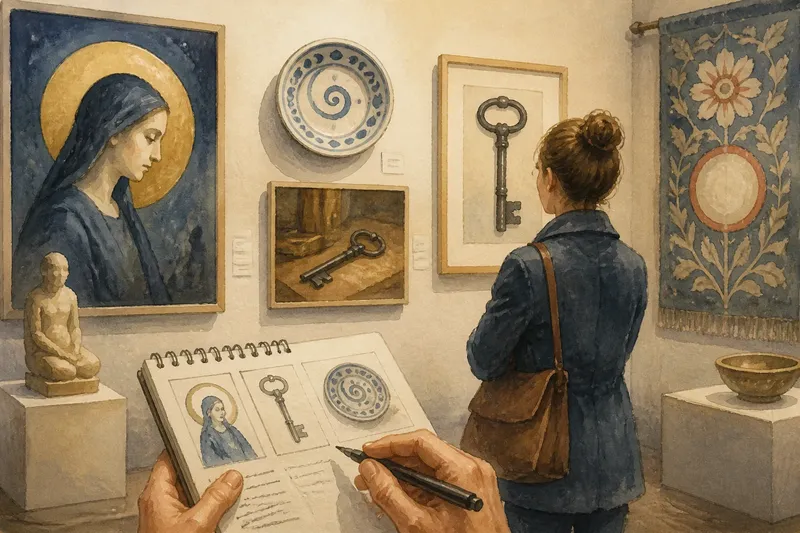
Say you choose the key as your motif after spotting one painted into a small portrait. In a nearby room, you notice a metal key among household objects, its teeth and worn handle presented plainly. Later, a print shows a key enlarged until it becomes almost a graphic shape. You note that the first key is part of a person’s appearance, the second is an object designed to be held, and the third reads almost like a sign. The comparison gives you a clear question to consider, without proving a shared meaning.
It is not worth the effort to record every appearance or force a connection between objects that share only a superficial resemblance. A small number of well-chosen encounters can make a stronger visit than an exhaustive tally. If a motif disappears for several rooms, that gap is part of the route, not a reason to hurry through everything else.
What should you do when a motif is hard to follow?
How do I choose a motif if I am visiting with children?
Choose something easy to spot, such as circles, animals or a particular colour, and let each person point out one appearance at a time. Ask what has changed around it rather than insisting on a correct interpretation.
Should I read the labels before or after looking?
Try looking first, so your initial observations are your own, then read the label for context. If the label changes your reading, note what it adds without treating it as a correction to everything you noticed.
What if I see the motif only once?
One encounter can still be worthwhile, though it may not support a route across the collection. Follow a related feature—such as the object’s material, position or repeated pattern—or choose another motif that recurs more freely.
Can I follow a motif through an exhibition rather than a whole museum?
Yes; a focused exhibition can make comparison especially clear because the works are gathered around a shared subject or period. Keep your own motif distinct from the exhibition’s main theme, and notice where the two reinforce or complicate each other.
Leave with a question, not a verdict
At the end of the visit, look back over your notes and choose two or three appearances that genuinely differ. What changed: the material, the scale, the company or the role the motif played in the image? You might also notice that your first assumption shifted as you moved between rooms. That change is part of what this way of looking makes visible.
A museum visit built around one motif need not produce a single answer. Its value is a more attentive kind of comparison: seeing how a familiar shape or image can be decorative in one setting, practical in another and charged with meaning in a third. Keep one unresolved question with you—perhaps why a motif is absent from a work where you expected it. It gives your next museum visit a place to begin.